Line Art Tulips Floral Seamless Patterns
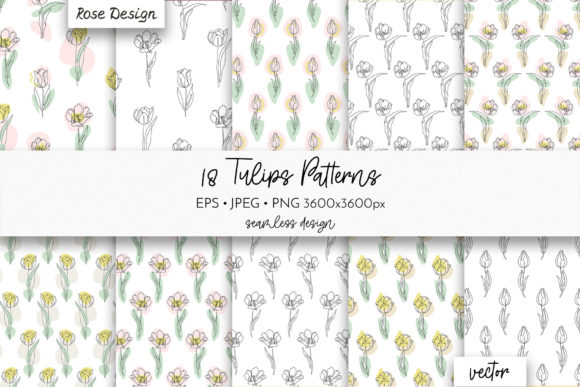
Minimalist, hand-drawn, and intentionally versatile — the Line Art Tulips Floral Seamless Patterns bundle delivers 18 distinct floral motifs built around single-line tulip forms. Each design balances restraint and character: some incorporate subtle organic blots or soft pastel accents; others rely entirely on clean linework and negative space. Unlike mass-produced digital florals, these patterns were conceived for repetition without visual fatigue — a strategic advantage when building cohesive, scalable visual systems.
Why Seamless Line Art Matters in Real-World Design Work
Seamless patterns aren’t just decorative assets — they’re structural tools. When you choose Line Art Tulips Floral Seamless Patterns, you’re selecting designs engineered to tile flawlessly across surfaces of any size: from business card corners to textile yardage, web backgrounds to packaging wraps. That technical reliability reduces production friction — no more manual alignment, no unexpected seams at scale, no last-minute rework due to pixel misalignment.
This matters most when consistency supports trust. A brand using the same line-art tulip motif across email headers, product tags, and social media banners creates subconscious continuity. Customers don’t need to notice the pattern — they need to feel the coherence. That’s where thoughtful pattern selection becomes part of your communication strategy, not just an aesthetic afterthought.
Strategic Use Cases — Beyond “Pretty Backgrounds”
The value of Line Art Tulips Floral Seamless Patterns emerges most clearly when matched to specific goals:
- Branding refinement: Startups and small businesses often overcomplicate visual identity. A single, well-chosen line-art tulip pattern can serve as a unifying texture across letterheads, invoices, and presentation decks — reinforcing simplicity and intentionality without requiring custom illustration.
- Product differentiation: For makers selling stationery, fabric, or greeting cards, these patterns offer immediate design depth. A pastel-blotted tulip motif on kraft paper packaging signals warmth and approachability; the same motif in monochrome vector form on a tech startup’s pitch deck conveys precision and calm.
- Content efficiency: Educators designing printable worksheets or freelancers building Canva templates benefit from ready-to-use, high-resolution PNGs with transparent backgrounds. No time spent masking or adjusting opacity — just drag, scale, and deploy.
- Print readiness: With 3600×3600 px JPEGs (white background) and EPS10 vector files included, the bundle bridges digital and physical workflows. Vectors ensure razor-sharp reproduction on large-format prints; high-res JPEGs simplify use in platforms that don’t support vectors.
How to Choose — and When to Pause
Not every project needs a tulip. Before reaching for Line Art Tulips Floral Seamless Patterns, ask two questions:
- Does this reinforce, rather than distract from, the message? A delicate line-art tulip works beautifully behind light text or on neutral-toned merchandise — but it risks visual competition next to bold typography or saturated photography. Test contrast, scale, and density before finalizing layouts.
- Is repetition serving a purpose — or just filling space? Seamless patterns gain strength through intentional repetition. If you’re using one only once, as a single border or isolated icon, consider whether a standalone vector tulip (or no floral element at all) would communicate more clearly.
Also consider audience context. A wellness coach targeting midlife professionals may find the soft, organic quality of these patterns resonates with values of balance and groundedness. A fintech SaaS brand, however, might prioritize geometric clarity over botanical suggestion — unless tulips are part of a deliberate seasonal campaign or brand story.
What’s Included — And Why Format Variety Is a Practical Advantage
The bundle includes three file types — each serving distinct operational needs:
- 18 PNG files (3600×3600 px, transparent background): Ideal for digital mockups, layered web design, and print-on-demand integrations where transparency preserves flexibility. Use these when overlaying patterns on photos, gradients, or variable-color backgrounds.
- 18 JPEG files (3600×3600 px, white background): Best for quick insertion into presentations, newsletters, or platforms with limited layer support. White backgrounds eliminate blending surprises and speed up approval workflows.
- 18 EPS10 vector files: Essential for scalability without loss — especially for embroidery digitizing, signage, or packaging die-lines. Vectors also allow precise color replacement (e.g., switching from blush pink to deep navy) without redrawing.
Having all three formats means you’re not locked into one workflow. You can start with a PNG for rapid prototyping, switch to the vector for final production, and drop in the JPEG for client review — all without converting or compromising fidelity.
Risks of Using Patterns Without Strategic Alignment
Using Line Art Tulips Floral Seamless Patterns without clear intent carries quiet costs:
- Brand dilution: Applying the same pattern across unrelated offerings (e.g., a law firm’s invoice and a children’s book cover) weakens visual hierarchy and confuses audience expectations.
- Production slowdown: Assuming “seamless” means “plug-and-play” can backfire if tile spacing isn’t tested at actual output size — especially on textiles or large banners where subtle misalignment becomes visible.
- Creative stagnation: Relying too heavily on pre-made patterns can delay development of original visual language. Treat this bundle as a launchpad, not a ceiling — adapt motifs, combine with custom elements, or use them as rhythm guides for hand-drawn variations.
Long-Term Value — Planning for Reuse and Evolution
These patterns hold long-term utility when treated as modular components. For example:
- A stationery designer can build a core collection around one tulip motif — then introduce variations (blot, monochrome, double-line) seasonally, maintaining recognition while signaling freshness.
- An educator creating printable resources can assign specific patterns to content categories (e.g., pastel-blotted tulips for mindfulness worksheets, clean line-only versions for grammar exercises), using visual cues to support learning retention.
- A small-batch textile maker can test one pattern on scarves first, gather customer feedback on color application, then extend the same motif to tote bags or pillow covers — minimizing design overhead while expanding product lines.
That kind of scalability depends less on the pattern itself and more on how deliberately it’s embedded into your planning process. Ask: “Where will this appear at 10×, 100×, and 1000× scale? Who needs to recognize it instantly? What should it never be used alongside?” Answering those questions turns Line Art Tulips Floral Seamless Patterns from decoration into infrastructure.
Final Thought: Clarity Over Decoration
Good design decisions rarely begin with “What looks nice?” They begin with “What needs to be understood, remembered, or acted upon — and how can visuals support that?” The Line Art Tulips Floral Seamless Patterns bundle succeeds because it offers clarity: clean lines, predictable tiling, format flexibility, and restrained color. But its real value emerges only when paired with intention — when you choose a pattern not because it’s floral or trendy, but because it quietly strengthens what you’re trying to achieve.