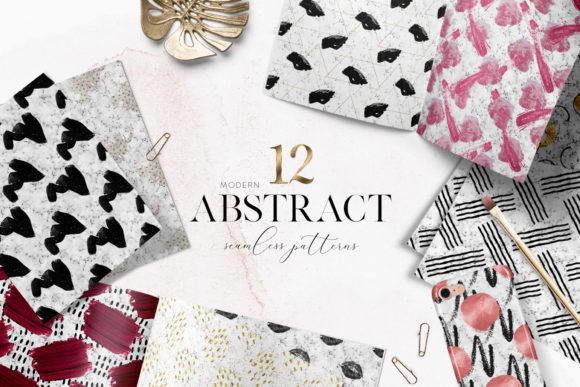
Modern Abstract Seamless Patterns
Modern Abstract Seamless Patterns offer a practical, versatile solution for designers and creators who need high-fidelity, repeatable surface textures without the time or technical overhead of building them from scratch. These aren’t stylized illustrations or decorative motifs—they’re engineered digital assets designed for functional integration across print, web, and presentation contexts. What sets this collection apart is its balance of aesthetic restraint and technical precision: each pattern avoids visual noise while maintaining enough rhythmic variation to feel intentional and contemporary.
What You Actually Get—and Why It Matters
The package delivers one .zip file containing 12 individual .JPG files—each sized at 12×12 inches and rendered at 300 DPI. That resolution ensures sharp output on professional print jobs, including business cards, packaging mockups, stationery, and large-format posters. Unlike lower-resolution or tile-limited alternatives, these files retain clarity even when scaled down for UI overlays or up for wall graphics—provided the base dimensions are respected in layout software.
Each file features a transparent background, a detail that significantly expands usability. This means you can layer patterns directly over photographs, gradients, or brand-colored surfaces without clipping masks or manual cleanup. In tools like Adobe Photoshop, Figma, or Canva, transparency enables non-destructive blending modes (e.g., Multiply, Overlay) to subtly reinforce typography or unify multi-element layouts.
Strengths in Real-World Application
Seamless tiling is where many abstract pattern libraries fall short—visible seams, inconsistent density, or awkward repetition break immersion. These 12 patterns avoid that pitfall through deliberate spacing, balanced contrast distribution, and subtle directional flow. Tested across multiple applications, they hold up well when tiled at 50%, 100%, and 200% scale in both vector and raster environments. One pattern with soft geometric interplay, for example, works equally well as a subtle backdrop behind a newsletter signup form and as a full-bleed textile swatch in a product catalog.
The “large size” claim isn’t marketing filler—it reflects genuine workflow efficiency. At 12×12 inches, each file covers a generous canvas before tiling becomes necessary. For users working in InDesign or Illustrator, this reduces the number of duplicate layers needed to fill a spread, minimizing file bloat and rendering lag. For bloggers embedding patterns into WordPress headers or email templates, it provides flexibility to crop tightly around focal content without pixelation.
Who Benefits Most—and Where It Fits Smoothly
Freelance graphic designers preparing brand guidelines often need scalable, neutral textures that don’t compete with logos or messaging. Modern Abstract Seamless Patterns serve that role reliably—especially versions with muted tonal ranges or low-contrast line work. Similarly, small business owners creating social media banners or printable marketing kits gain consistency without licensing complications: these are ready-to-use, royalty-free assets with no attribution requirement.
Educators building presentation decks or course materials benefit from the clean, non-distracting nature of the patterns. A soft wave motif, for instance, adds visual rhythm to a slide about data trends without drawing attention away from charts or bullet points. Bloggers and content publishers find utility in using one pattern as a recurring visual motif—say, as a header divider across blog categories—creating cohesion without repeating identical imagery.
Marketers running A/B tests on landing pages may use different patterns to subtly differentiate campaign variants. Because each file is self-contained and high-res, swapping them requires only a file replacement—not redesigning the entire layout. That speed matters when iterating under tight deadlines.
Practical Considerations and Limitations
These are JPG files with transparency—a technical nuance worth noting. While JPGs load quickly and are universally supported, they don’t support layered editing or alpha-channel adjustments natively. If your workflow depends on adjusting opacity per channel or applying non-destructive filters inside Photoshop, you’ll need to convert to PSD or PNG first. That’s a minor step, but it’s worth acknowledging for teams relying heavily on round-trip editing.
The collection contains 12 distinct patterns—not dozens. That’s intentional: breadth isn’t always better than curation. Each design occupies a specific niche—linear rhythm, organic scatter, minimalist grid, asymmetric balance—so redundancy is low. Still, users expecting maximal variety (e.g., seasonal themes, cultural motifs, or ultra-bold colorways) may find the scope focused rather than expansive. This isn’t a “one-stop” library for every possible context—but it excels within its defined range.
Color fidelity is consistent across files, but screen calibration affects perception. The patterns were created in sRGB, which ensures reliable display across most consumer and professional monitors. However, if you’re printing with a Pantone-matched press or exporting for wide-gamut displays, soft-proofing remains advisable—particularly for patterns with delicate grayscale transitions.
Integration Into Common Workflows
In Figma, drag-and-drop the JPG onto a frame, then use constraints to pin it as a background. Set overflow to “visible” and adjust scale manually—no plugin required. In Canva, upload the file, select “Use as background,” and choose “Tile” from the position menu. For print prep in Adobe InDesign, place the image, set Object > Text Wrap > Contour Options to “Alpha Channel,” and adjust offset values based on surrounding text weight.
For developers embedding patterns into CSS backgrounds, convert one JPG to base64 or host it on a CDN, then apply via background-image: url(...) with background-repeat: repeat. Because each file is exactly 12×12 inches at 300 DPI, the physical pixel dimensions are 3600×3600—ideal for retina displays and responsive scaling.
Long-Term Value and Adaptability
Abstract patterns age well. Unlike trend-dependent illustrations or photorealistic textures, these rely on proportion, spacing, and tonal relationships—elements less subject to stylistic shifts. Used in a brand system today, they’re likely to remain appropriate five years from now, especially when paired with thoughtful typography and restrained color palettes.
The lack of embedded fonts, logos, or proprietary elements means there’s no risk of accidental trademark overlap or style misalignment. You control how much—or how little—of the pattern appears. A cropped corner treatment, a diagonal slice across a hero section, or a full-bleed overlay with 15% opacity all communicate different tones using the same source file.
That adaptability extends to audience perception. Research in visual communication suggests viewers process abstract, low-salience patterns more quickly than illustrative ones—making them effective for interfaces where cognitive load must stay low. They provide texture without demanding interpretation, supporting comprehension rather than competing with it.
A Final Note on Fit
If your projects involve frequent print production, cross-platform branding, or rapid prototyping—and you value predictability over novelty—Modern Abstract Seamless Patterns align closely with those needs. They won’t replace custom illustration or photography, nor are they meant to. Instead, they function like a well-chosen typeface: invisible when working correctly, noticeable only when missing. Their strength lies in reliability, not spectacle. For professionals who measure success in shipped projects—not just polished previews—that’s often the more valuable trait.