Set of Seamless Patterns with Geometric
Seamless patterns—especially those built around clean, repeatable geometric forms—are among the most versatile design assets available today. A Set of Seamless Patterns with Geometric isn’t just background filler; it’s a foundational tool for textile designers, branding professionals, print-on-demand entrepreneurs, and educators creating visual learning materials. When thoughtfully crafted, these patterns scale effortlessly across fabric, wallpaper, packaging, web interfaces, and even digital presentations—without visible seams, distortion, or pixelation.
Why “Geometric Knight Swords” Adds Meaningful Distinction
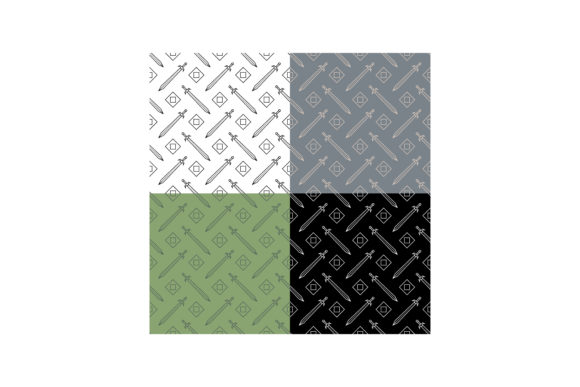
Not all geometric patterns are created equal. A subset like set of seamless patterns with geometric knight swords bridges abstract structure with narrative resonance. Think sharp angles echoing blade geometry, interlocking shields forming tessellated grids, or stylized tournament banners rendered in vector precision. These aren’t literal illustrations—they’re symbolic motifs that evoke medieval duel energy while maintaining strict scalability and repetition integrity. That duality makes them especially useful for themed apparel (think festival wear or LARP gear), boutique stationery, or educational posters about historical design language.
Common Missteps—and What They Cost You
Many creators rush into using a Set of Seamless Patterns with Geometric without verifying core technical and aesthetic fit. Here’s where things often go sideways:
- Assuming “seamless” means “universal.” Some files appear seamless at 72 dpi on screen but break apart when scaled for fabric printing at 300 dpi—or worse, when tiled across a 60-inch-wide roll. Always test the pattern at actual production size before finalizing.
- Overlooking vector vs. raster limitations. A pattern labeled “vector” may still contain embedded raster elements (like subtle textures or shadows). Those won’t scale cleanly and can introduce moiré effects on woven textiles. True vector-only files retain crispness at any size—verify by zooming to 1600% in Illustrator or checking layer structure.
- Misjudging color mode and gamut. RGB patterns look vibrant on screen but often shift dramatically when converted to CMYK for fabric dye-sublimation or screen printing. If your end use is physical output, request or convert to CMYK early—and soft-proof against your printer’s profile.
- Ignoring repeat type and tile boundaries. Not all seamless patterns use the same tiling logic. Brick, half-drop, and mirrored repeats behave differently on curved surfaces (like tote bags) or directional fabrics (like velvet). Check whether the set includes documentation on repeat type—and test on a mockup before bulk ordering.
What to Inspect Before Downloading or Buying
Before adding a Set of Seamless Patterns with Geometric to your toolkit, pause and verify these five points:
- File format clarity: Look for AI, EPS, or SVG—not just PDFs masquerading as vectors. A true vector file lets you recolor individual shapes, adjust stroke weights, or isolate sword motifs for standalone use.
- Tile dimensions and resolution notes: Reputable sets specify tile size (e.g., 1200×1200 px or 10×10 cm at 300 dpi) and include both RGB and CMYK versions. Avoid sets that only list “high-res” without concrete specs.
- Licensing scope: Does the license cover commercial fabric printing? Digital resale (e.g., selling POD mugs)? Social media templates? Read the fine print—even if it’s not buried in legalese. Many free downloads prohibit merchandising entirely.
- Design consistency across the set: A cohesive set of seamless patterns with geometric knight swords should share proportional rhythm, line weight harmony, and spacing logic. Inconsistent stroke thicknesses or mismatched motif scales create visual noise—not ornament.
- Real-world application examples: Trust sets that show how patterns behave on actual fabric swatches—not just flat JPEG previews. Bonus points if they demonstrate drape interaction (e.g., how a diagonal sword motif flows over a shoulder seam).
Better Choices Start With Intentional Use
Instead of dropping a geometric pattern onto a design and calling it done, ask: What role does this play? Is it establishing brand texture (like a subtle background on business cards)? Supporting storytelling (a tournament-themed event banner)? Or enabling production efficiency (a single tile that prints flawlessly across yardage)?
For example, one small business owner used a Set of Seamless Patterns with Geometric to line custom notebook covers—but chose a low-contrast, monochrome variant instead of a bold sword motif. Why? Because high-detail geometry competed with handwritten notes and reduced readability. A quieter, rhythm-based pattern (think interlocking hexagons with minimal linework) provided texture without distraction.
Another educator building medieval history lesson kits avoided overly literal “knight sword” patterns in favor of abstracted angular repeats—then paired them with labeled vector overlays (shield silhouettes, heraldic color guides). The result was scalable, classroom-friendly, and adaptable across handouts, slides, and bulletin board displays.
Final Practical Notes
If you're evaluating a set of seamless patterns with geometric knight swords, treat it like a material sample—not just a digital download. Print a 12×12 inch swatch on your target fabric. Drape it. Fold it. Hold it in natural light. Does the repeat hold up? Do sharp corners blur at seam intersections? Does the motif read clearly from 3 feet away?
Also consider future flexibility: Can you easily extract one sword shape to use as a bullet point or icon? Does the set include alternate colorways—or will you need to manually adjust saturation and contrast for accessibility compliance? Good pattern sets anticipate these needs and provide layered, well-named files.
Remember: A Set of Seamless Patterns with Geometric isn’t just decoration. It’s infrastructure. When chosen with attention to technical fidelity, aesthetic intention, and real-world constraints, it saves time, elevates quality, and strengthens visual communication—whether you’re launching a fabric line, designing a conference backdrop, or illustrating a history curriculum.