Seamless Digital Patterns Father PNG: A Practical Guide for Designers and Creators
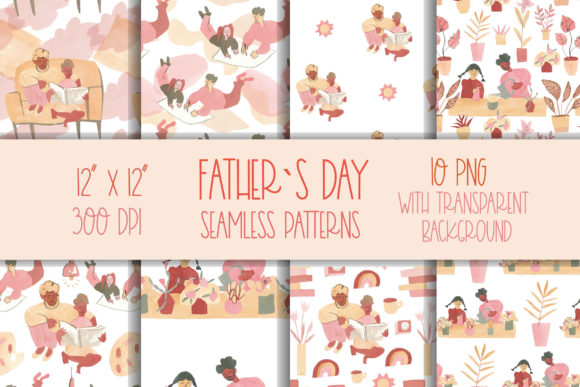
When designers, educators, product developers, or small-business owners seek high-fidelity, production-ready digital assets, Seamless Digital Patterns Father PNG often emerges as a precise and versatile solution. Unlike generic pattern libraries, this specific collection—comprising 10 meticulously crafted seamless patterns in PNG format—delivers technical consistency and creative flexibility. Each file is sized at 12×12 inches (3600 × 3600 pixels), rendered at 300 dpi on a fully transparent background. That combination isn’t arbitrary—it reflects deliberate alignment with professional print standards, digital interface scaling, and layered compositing workflows.
Why Seamlessness Matters Beyond Aesthetics
At its core, “seamless” means the pattern repeats infinitely without visible joints, offsets, or misaligned edges. This isn’t just about visual polish; it’s about functional integrity across contexts. For example, a textile designer preparing fabric mockups for client presentations needs to tile a pattern across a full garment visualization—without ghost lines or pixel shifts that undermine realism. Similarly, a UI/UX professional integrating subtle background textures into a dashboard must ensure the pattern scales cleanly across responsive breakpoints, from mobile to ultra-wide displays.
The Seamless Digital Patterns Father PNG set achieves true seamlessness through manual edge-matching, not algorithmic tiling. Each of the 10 patterns was constructed using vector-based precision and then rasterized at native resolution—preserving crispness while eliminating interpolation artifacts. That attention to construction explains why users report fewer post-import corrections when placing these files into Adobe Photoshop, Affinity Designer, Figma (via image layers), or even CAD-adjacent tools like Fusion 360’s appearance editor.
Transparency as a Workflow Accelerator
The transparent background isn’t merely a convenience—it transforms how these patterns integrate into complex compositions. Consider an educator designing printable STEM worksheets: overlaying a geometric pattern onto a labeled diagram requires non-destructive layering. With transparency, the pattern sits *behind* text and annotations without requiring masking, blending modes, or eraser cleanup. Likewise, a packaging designer applying a subtle dot matrix texture to a product label can adjust opacity, hue, or blend mode independently—no white fill to delete, no background to isolate.
This transparency also supports accessibility-aware design. When used as subtle background elements in digital interfaces, these patterns don’t interfere with contrast ratios required by WCAG 2.1. A light gray-on-transparent grid, for instance, adds depth without compromising text legibility—unlike opaque overlays that force designers to manually lighten foreground content.
Technical Specifications Decoded
Let’s unpack what “12×12 inches at 3600 × 3600 pixels, 300 dpi” actually enables:
- Print-Ready Precision: At 300 dpi, each inch contains 300 pixels—so a 12-inch dimension yields exactly 3600 pixels. This meets commercial printing thresholds for brochures, posters, stationery, and fabric swatches. No upscaling artifacts. No interpolation blur.
- Scalable Digital Use: Even at web resolution (72–96 dpi), the 3600-pixel canvas allows clean downscaling. A pattern used at 50% size (1800 × 1800 px) retains clarity for retina displays. At 25% (900 × 900 px), it remains sharp for mobile app backgrounds or email headers.
- Consistent Tiling Geometry: Because all 10 patterns share identical dimensions and DPI, they behave predictably when mixed in multi-layered documents. You won’t encounter mismatched tile densities when combining a wave motif with a minimalist line grid in the same layout.
That uniformity reduces cognitive load during asset management. Teams don’t need to write custom scripts to normalize resolution or crop excess whitespace—each file drops in, aligns correctly, and performs as expected.
Real-World Applications Across Disciplines
What makes Seamless Digital Patterns Father PNG broadly useful isn’t just its technical specs—it’s how those specs map to tangible tasks. Here are observed use cases across domains:
Product Development & Prototyping
Industrial designers embedding surface textures into 3D renders rely on seamless, high-res patterns to simulate material finishes—brushed metal, woven linen, or etched glass. Using these PNGs in KeyShot or Blender’s shader nodes avoids repetitive UV mapping tweaks. One hardware startup reported cutting texture setup time by 40% when switching from hand-tiled JPEGs to this standardized set.
Educational Resource Creation
Teachers building interactive PDFs or LMS modules use these patterns as low-cognitive-load visual anchors. A biology instructor applied a soft cellular grid behind anatomy diagrams—improving spatial orientation without distracting students. The transparency ensured labels remained crisp, and the 300 dpi preserved detail when printed for lab handouts.
Brand Identity Systems
Small studios developing brand guidelines often include pattern extensions for social media banners, presentation decks, or merch mockups. With 10 distinct styles—from organic watercolor washes to structured isometric grids—the set provides tonal variety while maintaining cohesion. A nonprofit rebrand used three complementary patterns across annual report sections, creating rhythm without repeating motifs.
Hobbyist & Maker Communities
On platforms like Etsy or Patreon, crafters sell printable planners, sticker sheets, and embroidery templates. These creators consistently cite the 12×12 inch size as ideal: large enough to tile across A4/Letter pages without visible repetition, yet manageable for home printers. One user shared how the transparency allowed them to add custom foil-effect layers in Procreate—something impossible with white-background alternatives.
Key Considerations Before Implementation
Despite their versatility, these patterns aren’t universally optimal—and recognizing limitations strengthens responsible usage:
- File Size Awareness: At ~12–18 MB per PNG (depending on complexity), bundling all 10 into a single web page may impact load speed. Best practice: compress via modern tools like Squoosh or ImageOptim before web deployment—or serve WebP variants where supported.
- Color Mode Clarity: These are RGB PNGs—not CMYK. While suitable for screen and most digital print services, offset printing jobs requiring strict color matching may need conversion and proofing. Always consult your printer’s ICC profile requirements first.
- Pattern Density & Context: A tightly packed micro-dot pattern works beautifully on business cards but may overwhelm large-format signage. Test at intended viewing distance: zoom out to 25% in your design app to simulate real-world perception.
- Licensing Scope: Unless explicitly stated otherwise, standard licenses typically permit commercial use—including client projects—but restrict redistribution of the unmodified PNGs as standalone assets. Always verify license terms before bundling into templates or SaaS platforms.
Workflow Integration Tips
Maximizing value starts with intentional integration—not just dropping files into folders. Try these evidence-informed approaches:
- Build a Pattern Library Folder Structure: Organize by function (e.g., /backgrounds/textures, /borders/frames, /overlays/gradients) rather than aesthetics. Tag filenames descriptively: father-png_wave-organic_transparent_3600x3600_300dpi.png.
- Create Smart Objects in Photoshop: Convert each pattern into a Smart Object before tiling. This preserves editability—you can update scale, rotation, or blend mode globally without reapplying layers.
- Use in CSS with Care: For web, declare background-size using
background-size: 12in;(not pixels) to maintain physical-scale consistency across devices. Pair withbackground-repeat: repeat;andbackground-color: transparent;to honor the alpha channel. - Test Print Output Early: Print a 2×2 inch swatch at actual size on your target paper stock. Check for banding, moiré, or unintended halftone interaction—especially with fine-line or gradient-based patterns.
Looking Ahead: Patterns as Living Assets
As generative design tools mature, static pattern libraries like Seamless Digital Patterns Father PNG remain essential—not as relics, but as calibrated reference points. AI-generated textures often lack predictable tiling behavior or consistent DPI fidelity. Human-curated sets provide reliability when deadlines loom, clients request revisions, or regulatory documentation demands traceable assets.
Moreover, their transparency-first, resolution-conscious design anticipates emerging formats: AR overlays benefit from alpha-channel readiness; variable fonts increasingly support pattern-based glyphs; and accessible PDFs require properly tagged, non-intrusive backgrounds—all areas where this set delivers measurable efficiency gains.
In essence, Seamless Digital Patterns Father PNG represents more than a download bundle. It’s a thoughtfully engineered component in the broader ecosystem of digital creation—one that respects both the craft of design and the constraints of real-world execution. Whether you’re laying out a conference banner, prototyping smartwatch UIs, or illustrating a children’s book, these 10 patterns offer consistency without compromise, flexibility without friction, and quality that holds up—not just on screen, but in print, in motion, and across generations of software updates.